
Digital & Media Investment forecasts - Irish Market 2026
Ireland enters 2026 with underlying economic momentum, albeit against a more volatile global backdrop. Ibec’s latest Economic outlook forecasts domestic demand growth of 2.8% in 2026, following an estimated 3.4% in 2025, and the labour market showing signs of cooling.
While the domestic picture remains broadly resilient, business planning continues to be shaped by external uncertainty, including geopolitics.
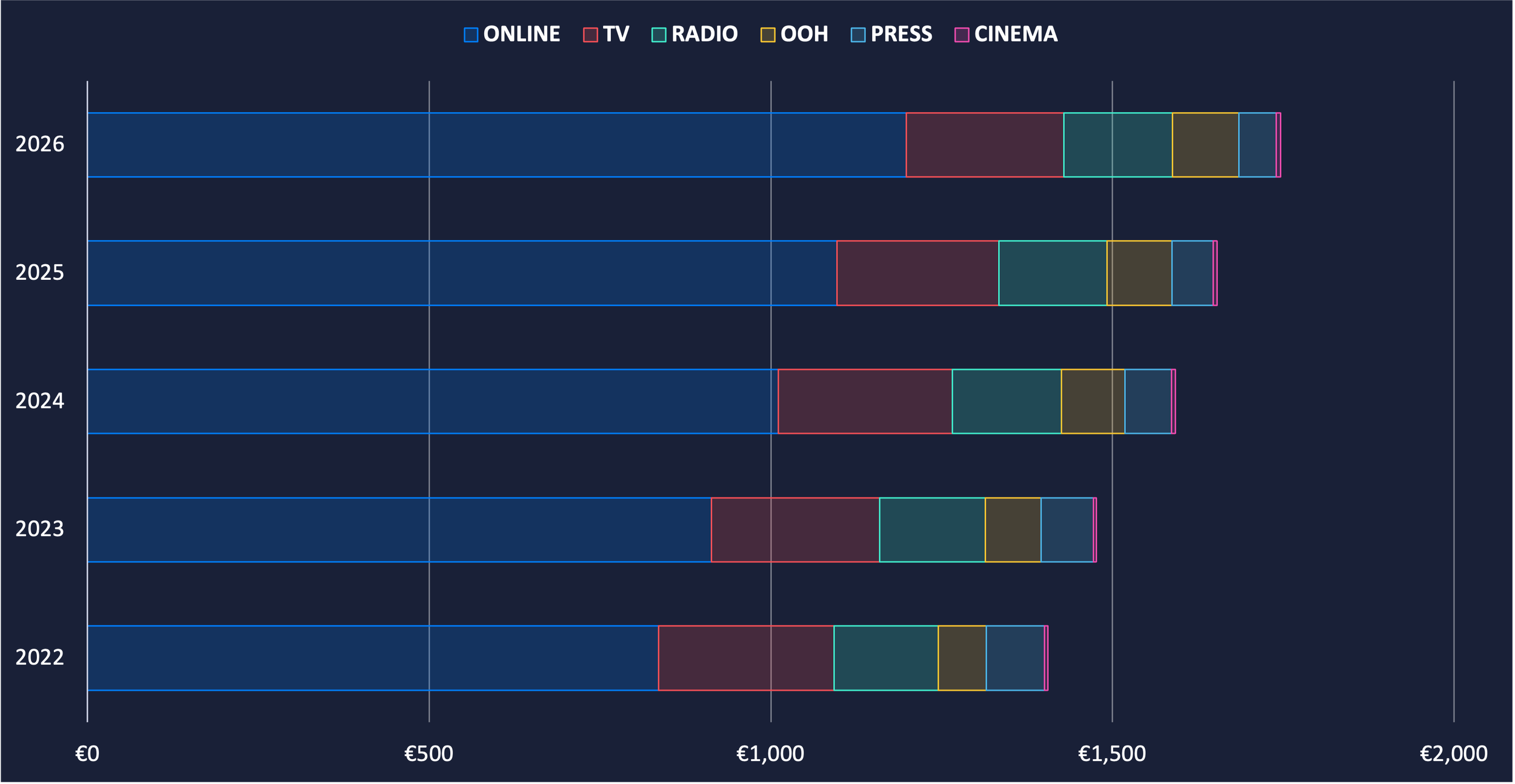
Against this context, the Irish advertising market has remained on a consistent growth path in recent years. We estimate that total media investment increased by 3.88% in 2025 to €1.65 billion, reflecting continued confidence and sustained momentum in digital channels.
Growth is expected to strengthen further in 2026. We forecast the market will expand by 5.62% to €1.75 billion, supported by modest domestic economic growth and resilient employment trends. As in recent years, online media will be the primary driver of this expansion, benefiting from structural shifts in consumption and the ongoing reallocation of budgets towards performance, video and platform-led environments.
However, this outlook is not without risk. The global environment remains volatile, and Ibec highlights the extent to which geopolitics and trade uncertainty are now shaping economic conditions and business sentiment.
While headline inflation is expected to moderate, cost pressures remain uneven, with grocery and everyday living costs continuing to rise. These dynamics are weighing on consumer confidence and, in turn, advertising decision-making.
Offline media is expected to remain under structural pressure, though performance varies by channel. Advertisers continue to prioritise flexibility, accountability and reach, reinforcing the longer-term shift towards digital and addressable channels.
Overall, the outlook for 2026 is one of cautious optimism: continued growth, but within a market defined by heightened volatility, economic sensitivity and rapid structural change in media consumption.
Christina Duff
Chief Commercial Trading Officer
Core
ONLINE
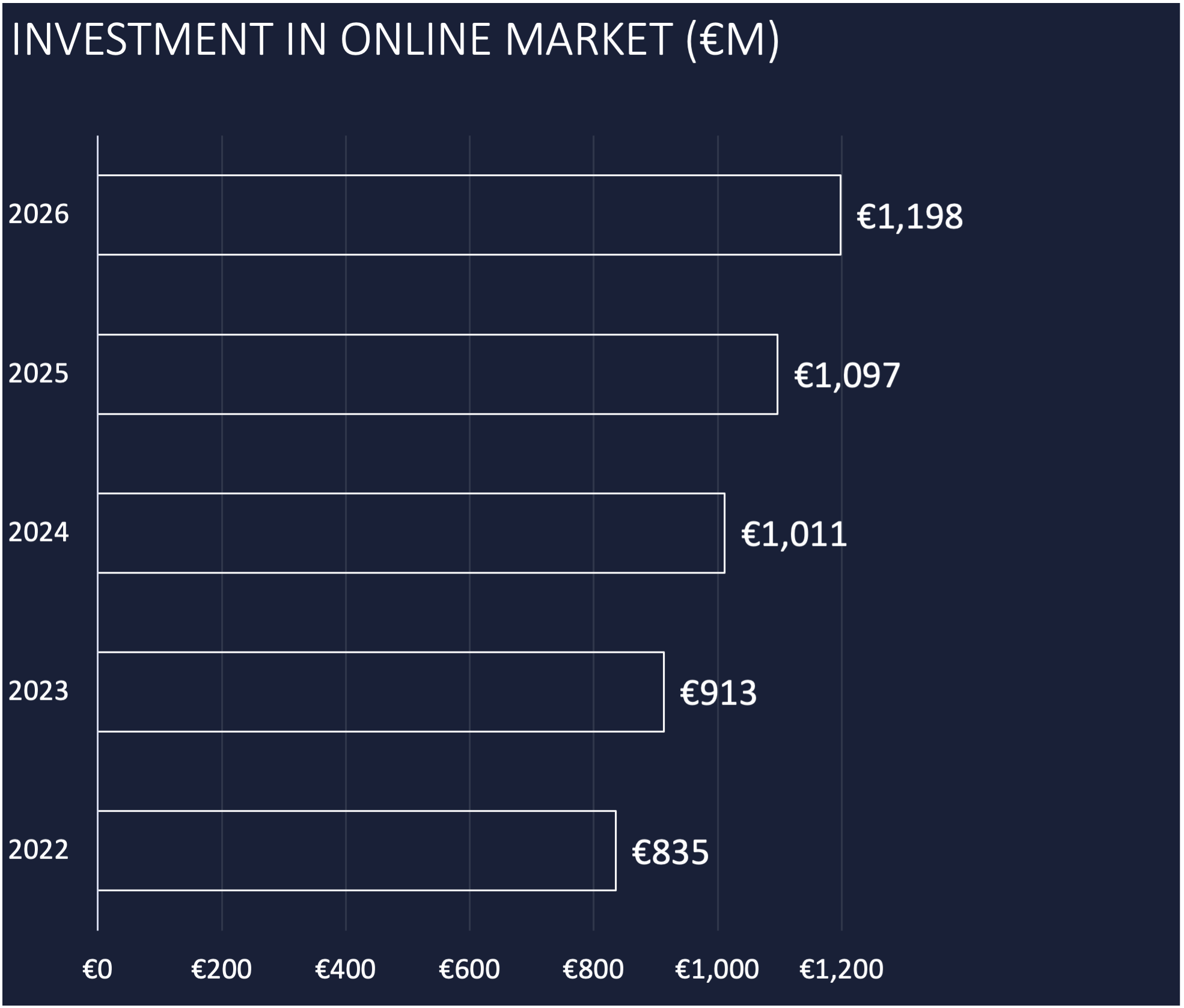
Digital advertising expenditure has grown by 8.5% in 2025, reaching €1.1 billion, representing 66% of total advertising revenue. Alphabet (Google) and Meta (Facebook and Instagram) continue to lead, accounting for 77% of digital ad spending and just over half of all advertising investment.
Search remained the largest single digital category, delivering stable, mid-single-digit growth, underpinned by its role as a performance-led, always-on channel. However, social and online video formats were the primary drivers of incremental growth, reflecting ongoing shifts in consumption and advertiser demand for scalable, video-led environments.
Core forecasts a 9.4% increase in the online advertising market in 2026, with total expenditure of €1.2 billion. Digital will account for 69% of the market. Social media, Digital audio and Video will continue to be the key drivers, with anticipated rises of 12%, 11.1% and 14.4%, respectively.
VIDEO (ONLINE VIDEO INC. SOCIAL)
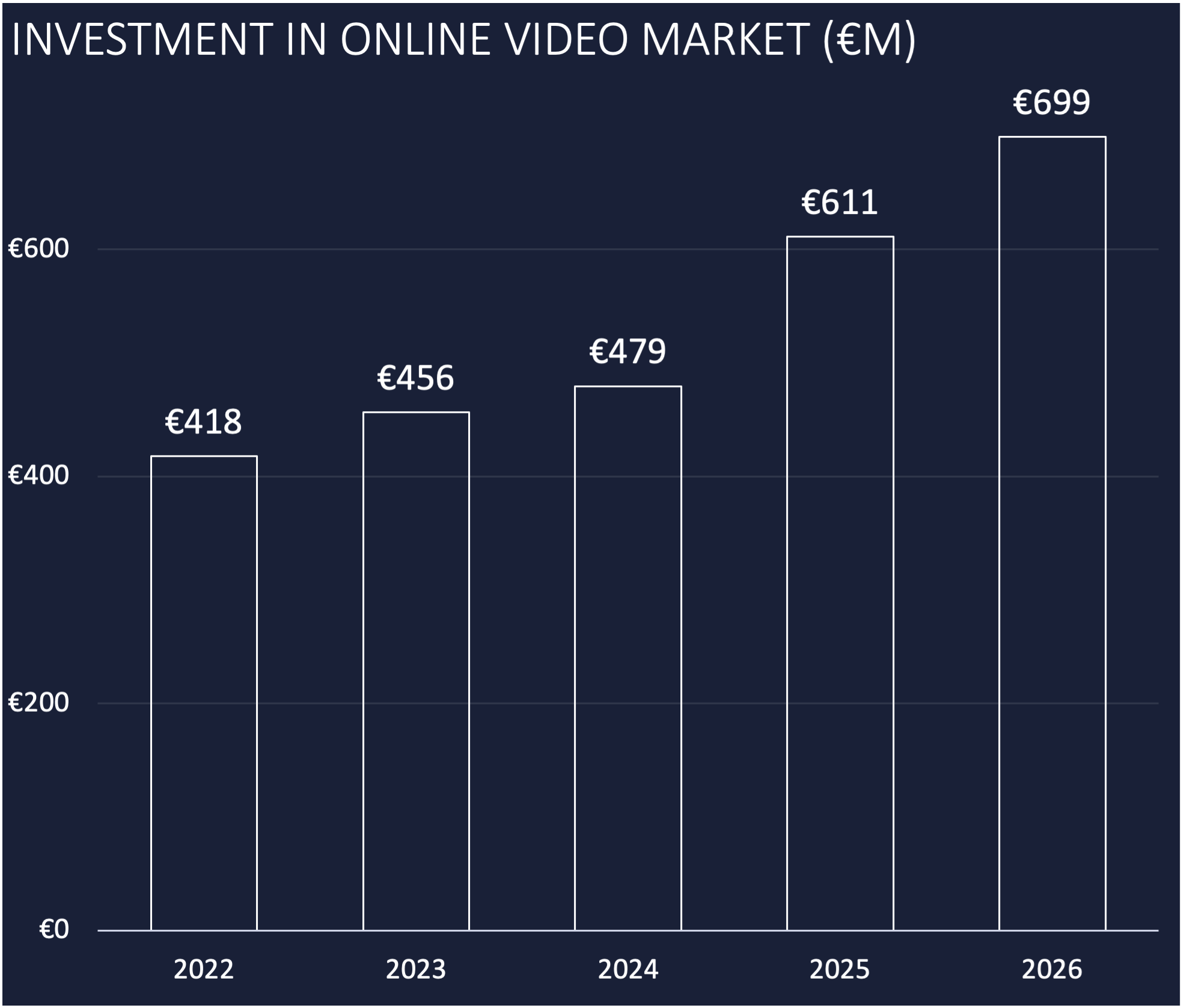
Changing consumer habits continued to support growth across all online video channels in 2025, with the market increasing by 27.5% to €611 million, driven by strong performance in social and platform-led video, including c.30% year-on-year growth on TikTok, alongside continued expansion in CTV and premium publisher video environments.
These underlying trends are expected to persist into 2026 but at a more modest pace. We forecast further growth of 14.4% for the category overall, taking total spend to €699 million. Within this, YouTube is expected to grow by 15.3% to €97.9 million, BVOD by 14.5% to €54.58 million, and Other Video including social media video, by 14.2% to €546.5 million, reflecting ongoing shifts in viewing behaviour and advertiser demand.
A key watch-out / opportunity for the year ahead will be the impact of the introduction of advertising-supported tiers across streaming platforms. While these models have the potential to expand the overall video advertising market by unlocking new inventory and audiences, there is also a risk that spend is redistributed from existing online video channels rather than incremental to the category. How these dynamics play out will be central to determining the pace and composition of growth in 2026.
VIDEO (TV)
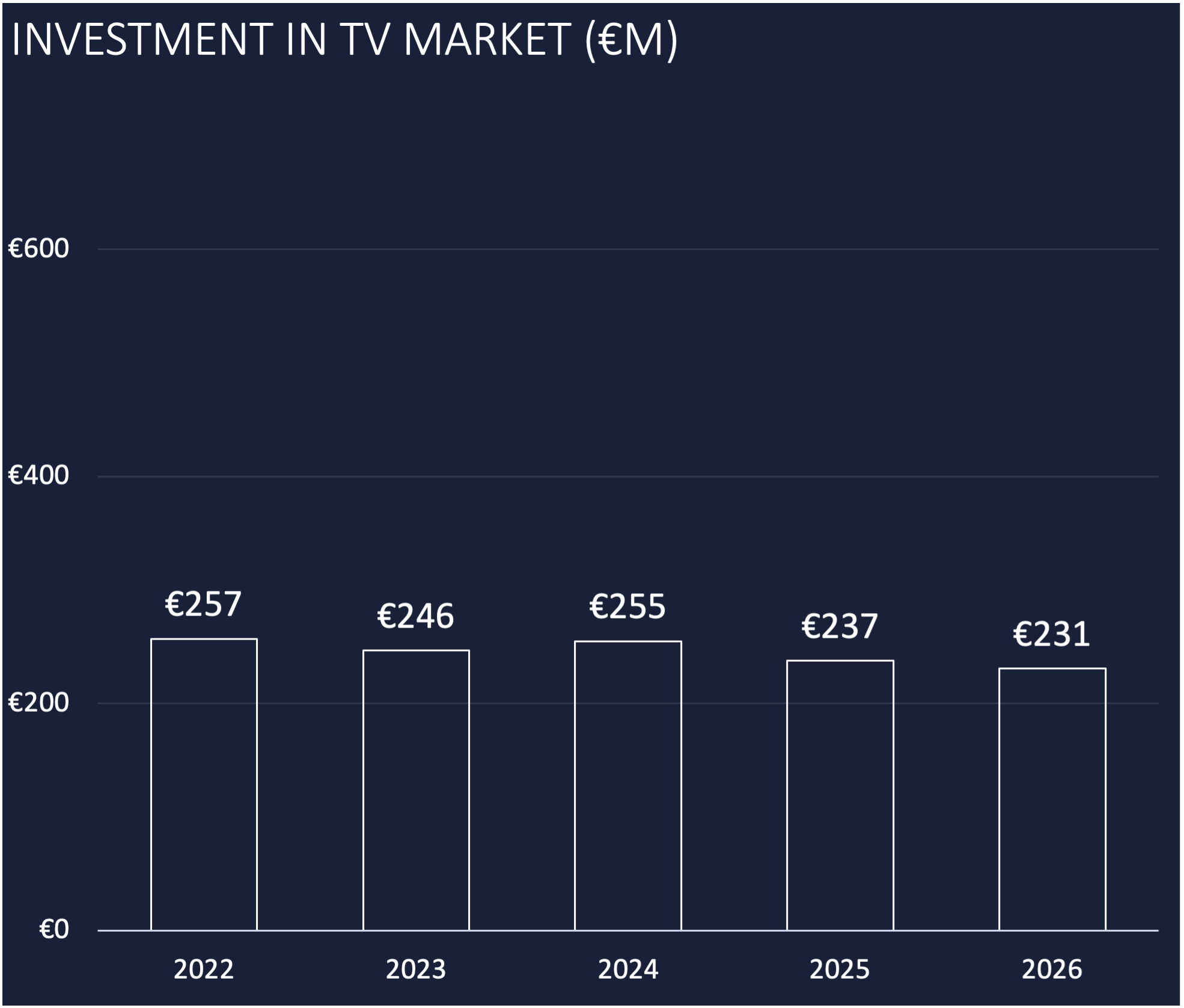
After a standout year in 2024, when television revenues benefited from an exceptional sporting calendar including The UEFA European Football Championship and the Olympic Games, 2025 represented a return to more typical trading conditions. Revenues declined in line with softer viewing levels, with TV advertising spend falling by 6.8% to €237.5 million.
Looking ahead to 2026, television revenues are expected to remain under pressure, with investment forecast to decline by a further 2.9% to €231 million. While the underlying trend remains negative, the pace of decline is likely to be partially moderated by periods of heightened viewing and advertiser demand, driven by tentpole programming such as the annual return of Love Island and I’m a Celebrity…Get Me Out of Here, the second season of The Traitors Ireland, and the FIFA World Cup.
AUDIO (RADIO)
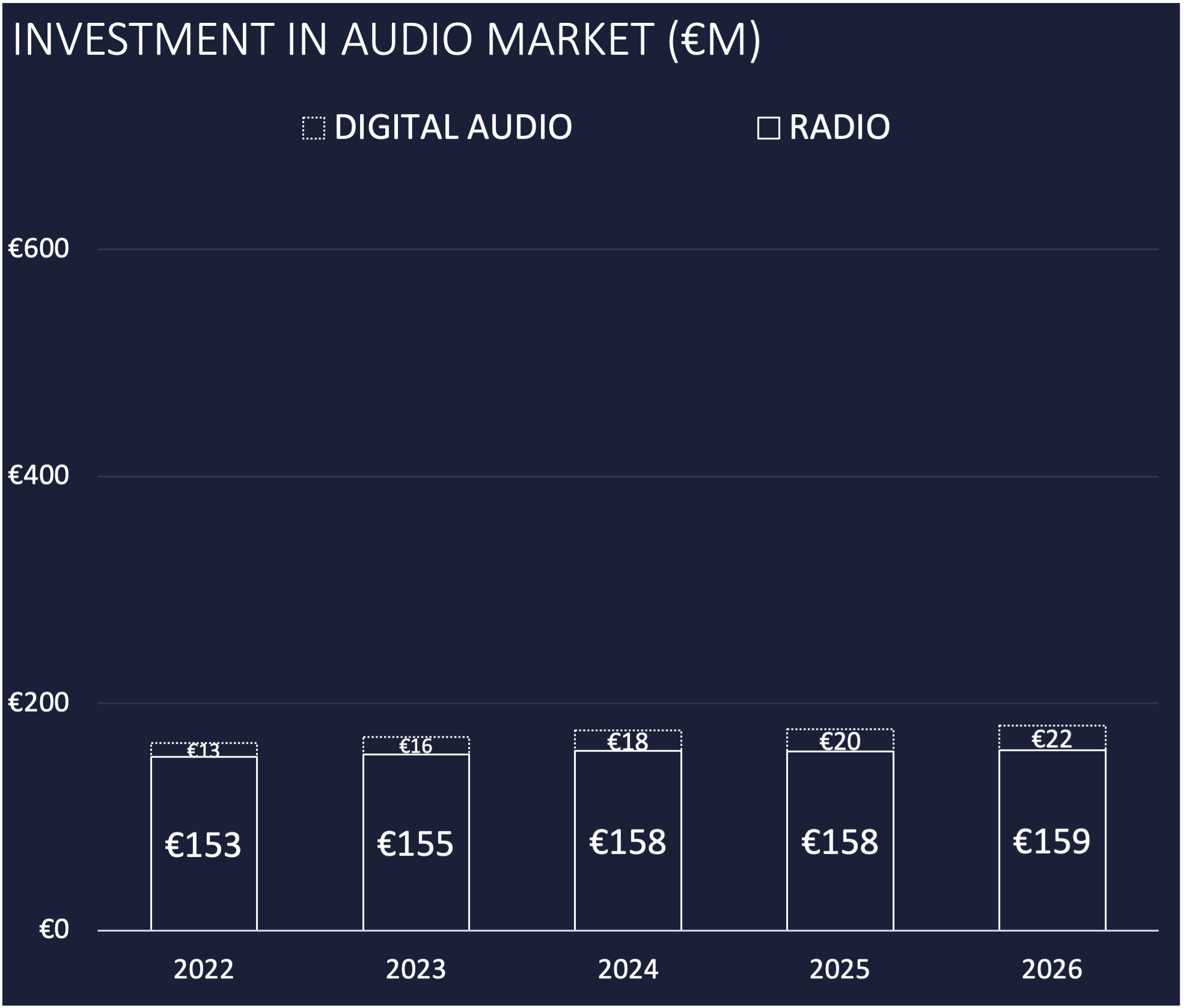
Irish radio advertising demonstrated modest resilience in 2025, with total spend reaching €157.7 million, a very modest decline of 0.25% year-on-year. Radio’s performance was supported by sustained demand for local and national broadcast inventory, stable commuter listening, and early digital audio monetisation via streaming and podcast channels.
Looking ahead to 2026, we forecast continued moderate growth in radio ad investment of 0.69% to €158.8 million. While traditional broadcast formats will face some pressure due to shifting listening habits, audience loyalty and strong reach underpin radio’s relevance for national advertisers.
Digital audio continued to grow in 2025, with advertising investment increasing by 9.7%, supported by sustained growth in streaming and podcast consumption. However, despite strong audience engagement, advertiser investment has lagged consumption trends, indicating a degree of under-investment in the channel relative to its reach and attention.
We expect this imbalance to begin correcting in 2026, with digital audio forecast to grow by 11.1%, as advertisers increasingly recognise its role within performance and video-adjacent strategies. Improved targeting, measurement and programmatic access, alongside expanding broadcaster and platform inventory, are expected to drive greater confidence and incremental budget allocation. As a result, digital audio is positioned to continue capturing a growing share of total audio investment in Ireland.
NEWS MEDIA
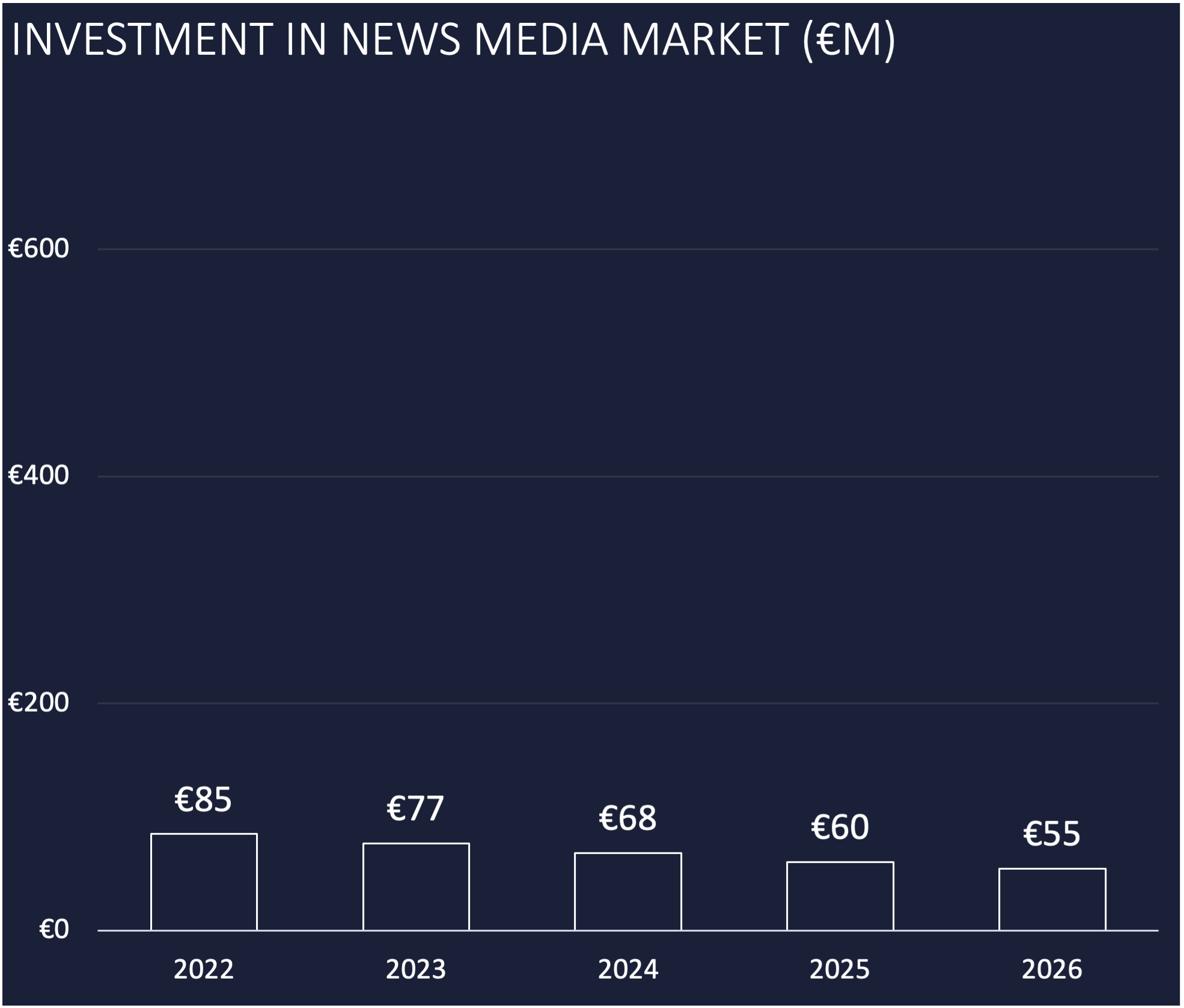
News media remained under pressure in 2025, with print advertising declining by -11.9% to €60.2 million, reflecting ongoing shifts in consumption and advertiser budgets. Despite this, trusted news brands continue to play an important role for advertisers seeking brand-safe, credible environments, particularly around major national and international moments.
Looking ahead to 2026, we forecast a further print decline of 9.5% to €54.5 million, with a potential short-term uplift linked to the FIFA World Cup, which is expected to support premium formats but not alter the underlying trend. On the digital side, we expect modest growth of 2.25%, driven by increased demand for high-impact tenancy formats, homepage takeovers (HPTOs) and partnership-led activity, as advertisers place greater value on trusted editorial contexts.
OUT-OF-HOME
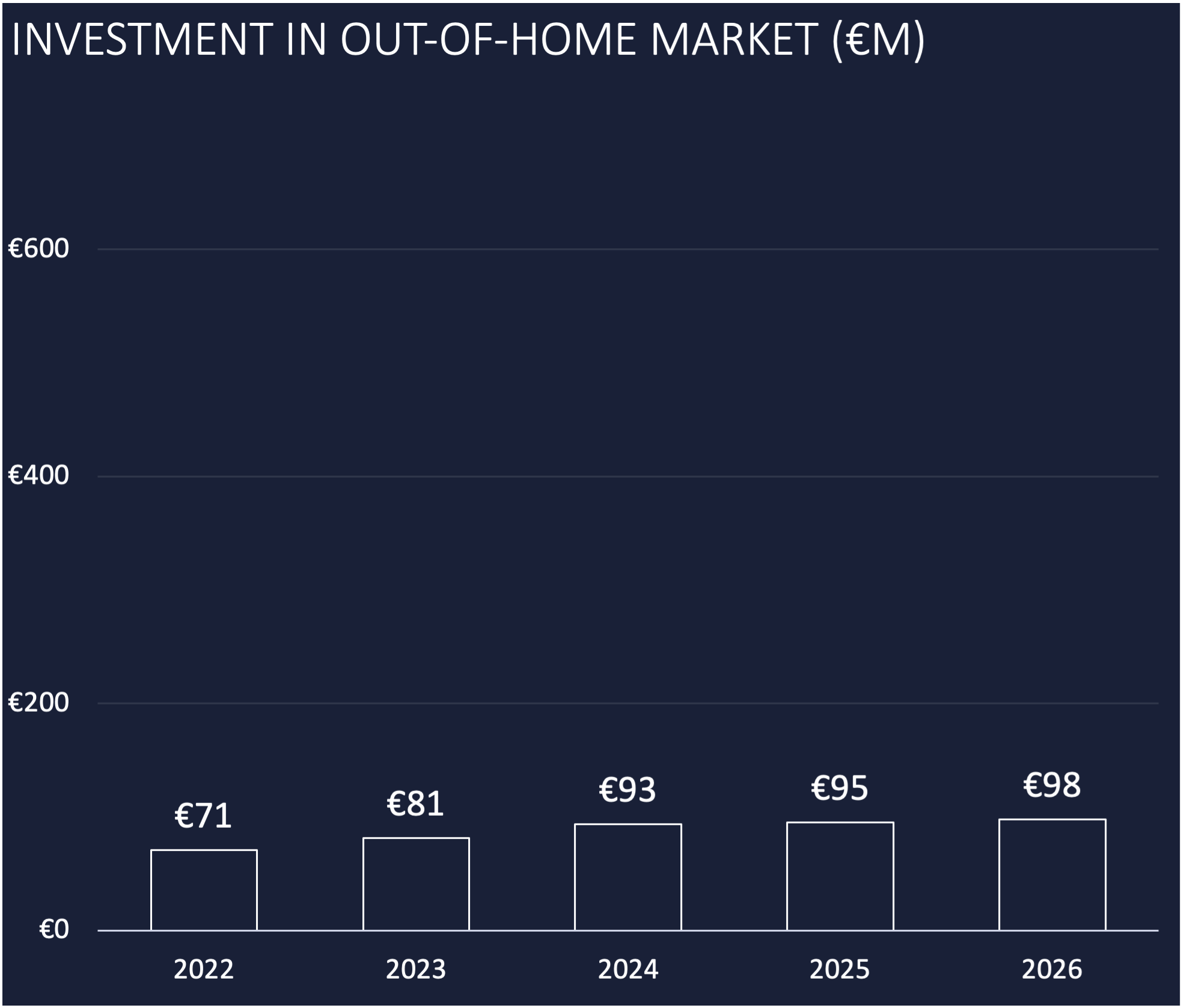
Out-of-Home advertising growth in 2025 came in much lower than initially anticipated, with revenues increasing by 1.9% to €95.1 million. While the category benefited from sustained urban mobility and commuter activity, expectations had been higher due to the presence of several large, high-profile campaigns that did not ultimately translate into the level of incremental spend originally forecast. This underperformance reflects a more cautious advertiser environment and increased scrutiny on effectiveness and attentive reach.
Looking ahead to 2026, we forecast a stronger performance, with OOH revenues expected to grow by 2.8% to €97.7 million. This outlook is supported by several factors, including continued digitisation of inventory, which is improving flexibility, creative relevance and measurability, and the emergence of retail media-linked OOH as a more accountable route to market. In addition, the FIFA World Cup is expected to provide a cyclical uplift, particularly for high-impact, national campaigns.